Farewell to the Tuamotus
Saecwen’s six weeks exploring the blue lagoons of the Tuamotus of French Polynesia has been one of the most exquisite experiences of our adventures to date. We have been at anchor in 15 different spots on five of the 80 plus atolls that make up this unique archipelago situated in the middle of the Pacific Ocean. The wildlife above and below the waterline has been stunning and the people we have met have been incredibly warm and generous.

Once we had familiarised ourselves with getting through the highly tidal passes, navigating across the uncharted lagoons and then safely anchoring amongst the coral-bommie minefields separated from the waves and swells of the Pacific Ocean by a tiny strip of land or reef we found some beautifully peaceful and protected anchorages often shared with just one or two other yachts (if that) and sometimes one or two local copra farmers ashore.

With all this space and relatively little human activity we were able to witness so much wildlife.

The atolls are made up of a ring of motus (small coral islands) separated from each other by mini passes where the water rushes in and out over the reef, often forming a shallow lagoon – the perfect habitat for the black tipped reef shark.
The black tips, like most sharks, need to keep moving at all times, and are often seen pacing the shallows hunting for prey. On one occasion we witnessed a pair of black tips devouring the remains of some parrot fish that had been left over from a spear fisherman - a gentle reminder that although they are generally very uninterested in humans and tend to swim gracefully past us - once there is blood in the water they fast switch into predatory mode.

Fakarava, one of the more inhabited atolls has a famous “wall of sharks”, where several species including black tips, white tips, grey reef sharks and tiger sharks gather in the atoll’s South Pass to hunt the abundant fish life that gathers there. On the full moon, when groupers by the thousand come to the pass to spawn there have been sightings of up to 700 sharks, who come to feast on the groupers and anything else they can get their teeth into in the abundant coral walls of the pass. One night at anchor on Fakarava we had a spectacular show of about fifteen grey reef sharks hunting around Saecwen’s hull.
Presumably the healthy shark population in the Tuamotus is thanks in part to the diverse and vibrant ecosystem of coral providing the perfect breeding zone for an infinite variety of fish.

The colours of the coral are spectacular, we often saw vibrant purple coral heads, bright yellow and green coral and every day discovered a new species of fish we had never laid eyes on before: bright yellow and black butterfly fish; parrot fish of every shade of turquoise and green (and some even orange); tangs with wispy tails; stripey sturgeon fish; grumpy looking spotty and stripey groupers; needle fish, unicorns and even a whole school of bonefish – a special treat for Charlie.
Aside from the fish we also saw sting rays, giant sea worms, moray eels, spidery star fish, ‘christmas tree’ anemones and bright blue clams and once swam through a school of friendly jelly fish that didn’t seem to sting. Sadly we only saw two turtles in all our time in the Tuamotos, severely under threat as still being hunted.


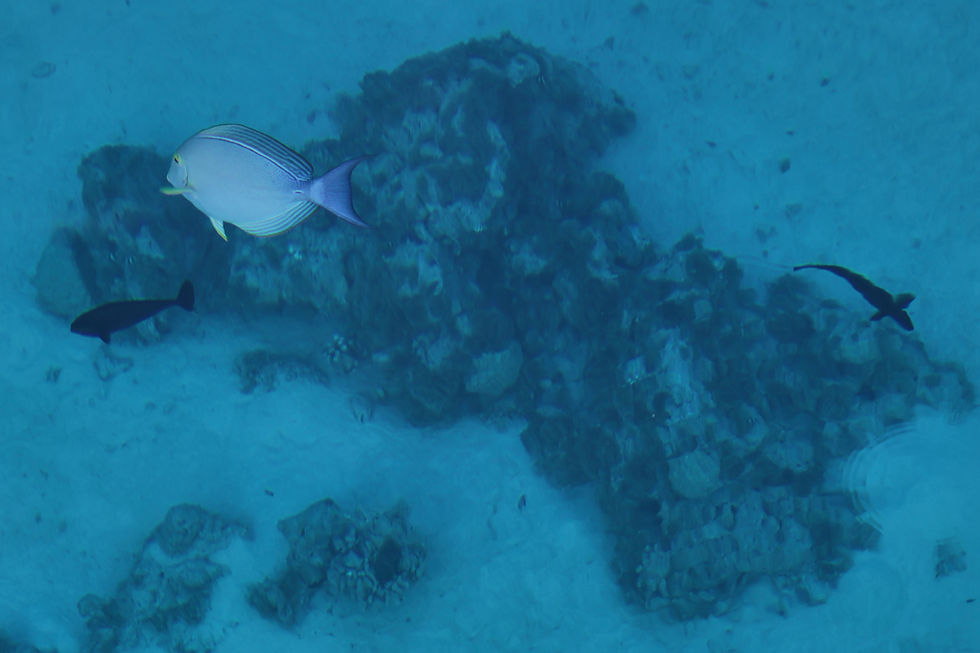
The water is exceptionally clear on most of the atolls, the colours are incredible - and also the perfect conditions for learning how to free dive - a key life skill to work on for untangling the chain from a bommie, if needed.
Our snorkelling exploits grew more adventurous (particularly as we started to grow used to being surrounded regularly by sharks) – which culminated in us drift snorkelling the eastern and middle passes of Tahanea Atoll, whereby we punched out of the pass against the incoming tide in the dingy and then jumped overboard and snorkelled the spectacular coral walls, We were securely attached to the dingy by a length of rope as the tide swept us back into the atoll’s lagoon. An unforgettable experience to see the geology of the pass under water as well as the abundant life in the walls either side.
There is lots happening above the surface too and the birds also seem to thrive with the abundant source of fish. One of the most curious sights was the sea-blue reflected onto the underside of the wings of the white fairy terns making them look like a bright blue bird.
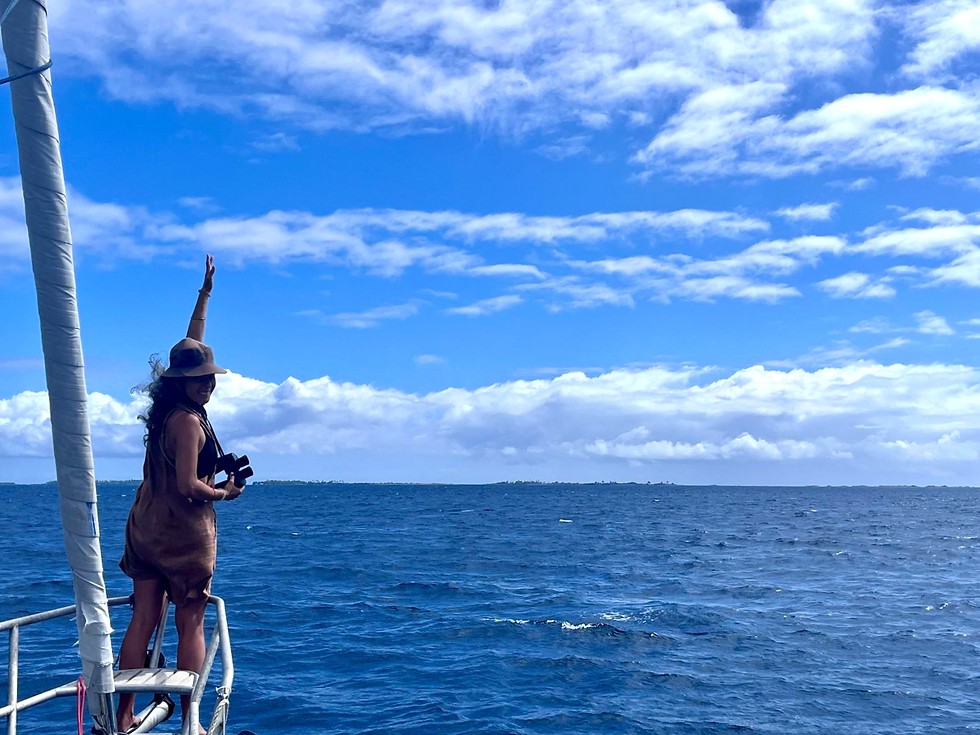
We saw several species of tern who nest on the more remote atolls where the flora is more diverse. A special moment when arriving at Tahanea, a stunning large uninhabited atoll, was to be greeted by a red footed boobie who promptly landed on the main boom as soon as we arrived.

We also regularly enjoyed seeing the aerial combat of the frigate birds, chasing the recent catch from the boobies and terns as well whimbrels and the more solitary grey and blue herons who would perch on the volcanic ridges to hawk the shallows.
One of the only viable economic activities for the small island communities of the Tuamotus is copra harvesting, which involves collecting coconuts, cutting them in half, leaving them to dry before scooping out the flesh, then laying that out to dry for a few days before bagging them up and sending off to Tahiti to be processed into coconut oil.

On one of the eastern motus of the atoll of Makemo we spent some time with Rosin and Tuorana a friendly local copra farming couple who plied us with fresh coconut and even gave us a huge live coconut crab to eat.

These are giant blue land crabs that live off coconuts and have a set of very large claws. To our horror our crab ended up escaping from his hessian sack in the cockpit during the night. After spending almost an hour searching the ship for him we concluded he could only have jumped ship to escape ending up in the pot.

We were actually slightly relieved as it seemed a shame to kill such a beautiful creature, although for a while we did worry that he might still be hiding somewhere deep in the boat waiting to sally forth and nip us in the middle of the night. We exchanged flour for coconuts and were treated with a delicious coconut bread cooked in leaves on a coconut fuelled fire.

On Tahanea Nico, a lone copra farmer, sold us for around 20 euros a sack of a dozen live lobsters he had collected off the outer reef. A wonderful Sunday lunch beach barbecue ensued which fed the crews of the three other yachts in the anchorage, bringing together our cosmopolitan sailing community hailing from afar as the UK, Catalonia, France, Israel, Norway and Australia.

Within the archipelago there are a few islands that have a villages of a few hundred inhabitants and one of our favourites was Makemo, the administrative centre of the middle group of atolls. Its community is given extra vitality by its secondary school, which takes in all the children from all the neighbouring islands. Hoard’s of children would be fishing at dawn on the pier, cruising the sandy roads on bikes and in some cases selling us more coconuts.
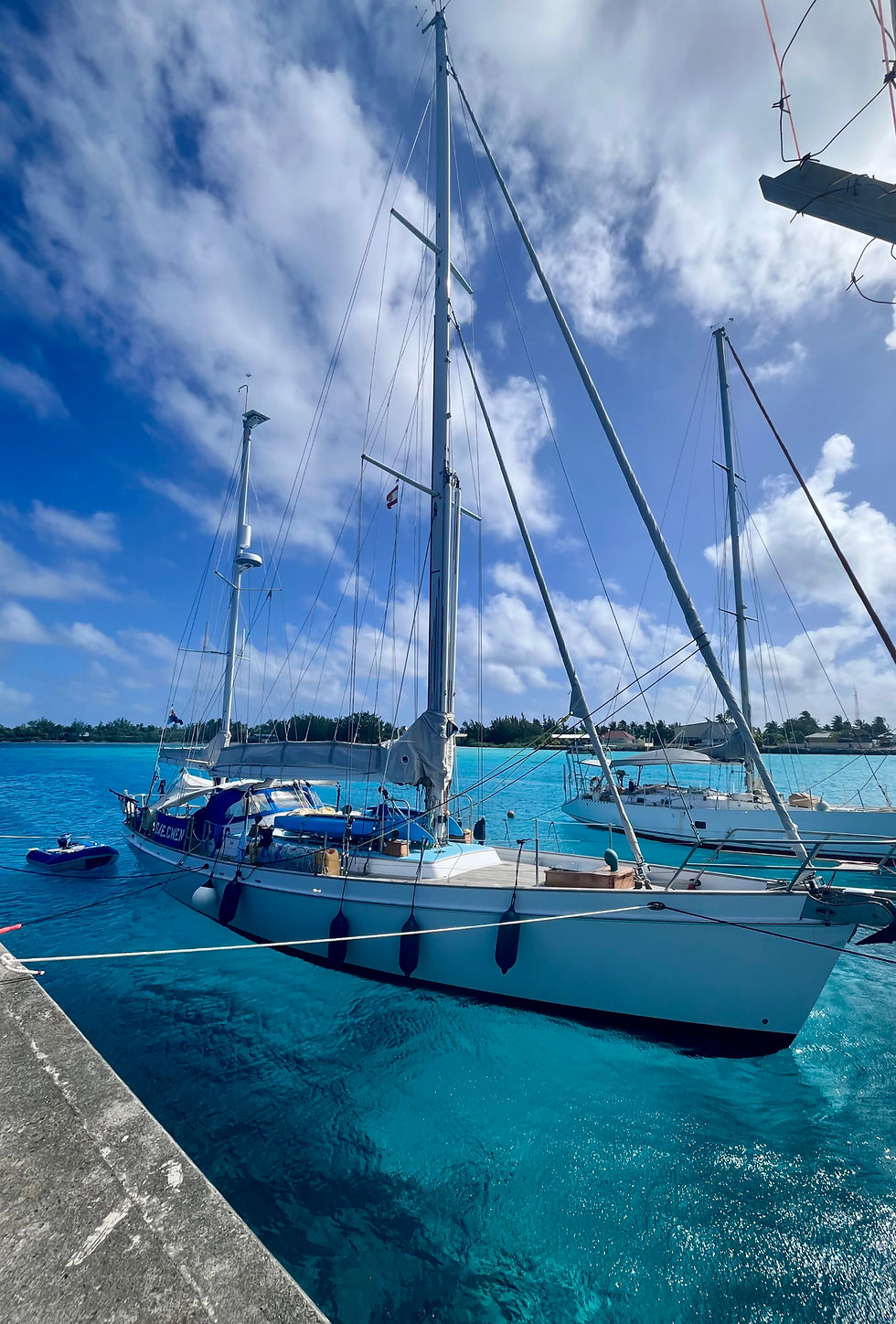
On one evening Heloise befriended a group of young teenage girls who were intrigued by Saecwen and where we had come from. “did you see whales? did you see dolphins? did you see mermaids?” they kept asking. On one of our evening strolls across the atoll having enjoyed a rare meal out at the one local restaurant, we stopped by one of the many churches which was filled with around 200 teenagers all singing their hearts out in Pau’motu, the language of the Tuamotus. It was an incredibly special moment, and the sense of community spirit on this island is still thankfully very much alive.

Just next to the catholic church on Makemo was a community shrine known as a marae. Many homes also have their own family marae, these are open air structures usually built out of large chunks of coral and serve as a place for honouring ancestors. These would have been the main focal point for traditional ceremonies before the arrival of the missionaires in the 19th century and today often sit alongside the newer churches.

Six weeks on five atolls is merely a whistle stop tour of the Tuamotus. Most cruisers we meet here spend at least a year (and many two) exploring French Polynesia. This is a truly special place and it is with heavy hearts that the time has come to say farewell to the Tuamotus as we prepare to set sail for “civilisation”, in the form of the bright lights of Papeete, the capital of Tahiti.


Even more beautiful and magical colours than ever - incredible fish and diving - so wonderful to see!
Wonderful! Thank you for the insights the blog give us all!
We’re running out of superlatives but please keep the posts coming - they are memorable.
What incredible experiences you have had. Lovely to share them given your wonderful descriptions and filming. I'm full of admiration (but not envy!)
This is a fine tale beautifully told and illustrated. - It seems you are getting everything and more you hoped for from this voyage - You are a long way from the sometimes grim and murky waters of the Irish Sea! Continues safe travels and keep blogging - My very best to you Charles and all the crew of Saecwen and "may the wind be always at your back" William