Les Isles Gambiers
The Gambier islands form a small archipelago in the southeastern part of French Polynesia and are one of the natural first destinations when crossing the South Pacific from Central and South America. We chose to make Saecwen’s transpacific landfall here rather than the more popular Marquesas islands further north primarily due to the huge number of yachts which we knew were heading to the latter. We were delighted with our decision not just because of the reports of unsustainably crowded anchorages up in the Marquesas, but also because in these beautiful islands we found a truly stunning tropical paradise where we were able to spend three very happy weeks exploring both on land and by sea.

The archipelago covers an area of 27km2, with ten islands and islets situated within an outer reef which is the remains of the volcanic caldera from where these islands emerged. The main islands are covered in healthy sub-tropical forests, with a variety of beautiful frangipani, mango, bananas and breadfruit growing near the coastline and casuarina pine forests dripping in lichen higher up. There is even a surprising abundance of wild grapefruit, much to Charlie's delight as this is his favourite breakfast. The paths through the forests show remnants of ancient trails that would have been used by the first communities who lived here trading fish and fruit between the different islands.

During our three weeks in the islands we managed to climb the two main peaks on Mangareva as well as hike the main ridge line and across the main island to its western shoreline. After several months in the sweltering equatorial tropics we also loved the more temperate climate, being several degrees cooler than Panama.

The islands were originally populated by Polynesians from the more westerly islands near Tahiti around 1,000 AD and later in the 18th century were dominated by an influx of missionaries from France who built an extraordinary number of churches. Although the local language of Mangareva is now practically extinct and everyone speaks French, the Polynesian culture of drumming and dancing is still very much alive and with the July festivals coming up we were delighted to hear drumming practice most nights reverberating across the anchorage.

The Gambiers is home to around 1,200 people, which is a significantly higher population than the neighbouring Tuamotos archipelago, whose populations are largely in decline due to limited economic opportunities beyond the back-breaking work of copra (coconut) harvesting. 70% of the Gambier population work in the active pearl farming industry and this has provided a unique opportunity for young people to stay on the island. There are two schools, a small airport strip on one of the outer reefs and a weekly supply ship from Tahiti.

The islands have the most prolific pearl farming industry of all French Polynesia. Each ‘farm’ consists of a rented part of the lagoon where the oysters are cultivated and a floating structure upon which the grafting and harvesting takes place. Pearl farming technology was introduced to Polynesia in the 1960s from Japan and involves a series of very specific steps requiring significant skill and resource. We learnt all about it on an exceptional tour from a local pearl farming family.

Firstly, a series of ‘collectors’ traditionally made from a local bush but now sadly from plastic nylon rope are hung in the lagoon from buoys to collect the floating oyster larvae (or spat) who cling on to the nylon strands and grow into small oysters. Once the spat reach a certain size they are then collected and hung on (another) plastic rope to grow to the next stage and eventually transferred to what is described as a kangaroo sack with several pockets, so that they can be easily taken in and out of the water for cleaning during the 3 years that they mature until ready for grafting.
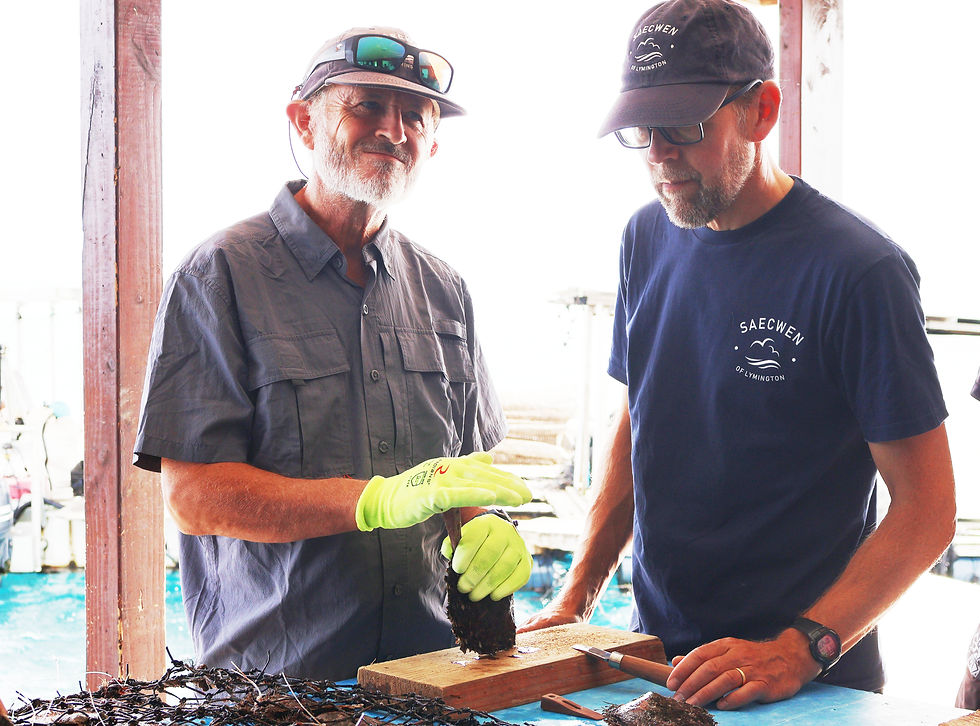
Grafting involves carefully opening the oyster (without damaging it) and inserting a tiny piece of shell (nucleus) and a graft of dark flesh from a donor oyster. The colour of this graft is carefully chosen to give the pearl it’s unique tone. If successfully accepted by the oyster this then grows over the next two years into a mother-of-pearl. Finally, five years on from the start of the process the oysters are harvested and again with the skill of the specially trained grafter the pearl is extracted, and if the host remains healthy a new nucleus and graft will be inserted for a second harvest.

Sadly, the pearl farmers in the Gambier have noticed a significant decline in spawning of the oysters over the last few years which could be due to the increase in water temperature caused by climate change or hotspots of microplastic accumulation (unfortunately in part caused by the pearl farming itself) which may be affecting the fragile lagoon ecosystems.

From our initial arrival point of Rikitea harbour in Mangareva we were able to make various forays out to the other islands, with Saecwen enjoying beautiful anchorages along the west coast of Taravai and out at the small barrier islands (or motus) near the airstrip. Here we found abundant aquatic life is with lots of wonderfully healthy coral. We snorkelled with black and white tipped reef sharks, huge groupers, moray eels and other predators as well as a huge diversity of beautiful multi-coloured smaller fish, anemones and other marine life.
We also enjoyed some great kayaking expeditions along the reefs in Saecwen’s faithful twin Kayaks, the Blues Brothers.

The lush green forests of Mangareva and the rich blue underwater life were both an incredible welcome gift to French Polynesia; it was definitely a fitting reward for the 21 days we spent at sea getting here.


Another really beautiful blog!
Brilliant. Love this. Will you get time to go to Raja Ampat when you get to Indonesia? One of my favourite places in the world - amazing marine life xxx
Splendid (again!). Hope the supply ship from Tahiti had been warned of your arrival.
Wonderful footage again with accompanying fascinating commentary and music. Sharing this with many friends, thank you.!
Wonderful , thanks for sharing
Sounds fascinating