The Roaring Forties
On October 3rd Saecwen took her departure from the remote Polynesian island of Rapa Iti, bound for Chile, over 4,000 miles to the southwest.
Our departure was fraught with unexpected mishap. Firstly, whilst letting go our bow rope a pair of very expensive and fashionable spectacles managed to slip off the nose of crewmate Clemence into the sea. Without hesitation she plunged headfirst over the side after them, much to consternation of our lovely farewell committee of islanders and to the total bewilderment of the skipper – who really hadn’t been anticipating a full “man overboard” situation just one meter from the dock. Amazingly Clem dived down fast enough to retrieve her glasses from the shark infested water and then pulled herself up a fender rope from where crewmate Tom hauled her safely back aboard.

Next, after motoring less than forty-five minutes to clear the wind shadow of the island, strange violent noises started blasting out from the engine and alarmingly the cabin filled with noxious smoke. The coupling which attached the exhaust outlet to the back of the engine had chosen this moment to sheer a fastening bolt – spraying the engine bay with circulating water in the process. After a couple of hours of exasperating tinkering with the fitting, which mostly involved Tom lying on top of the engine trying to realign the various surfaces of the fitting’s sealing joint, we fixed the problem with cable ties, liquid gasket and a permanently attached mole grip, allowing the engine to safely restart.

This however was not the end of our problems given the sudden ingress of salt water had shorted an electrical circuit board, resulting in the loss of all data into our crucially important battery monitor screen. An anxious night was spent hove to under the lee of Rapa awaiting for the UK to wake up so we could seek help from Dave, the electrician back home who had originally wired up the boat. Thankfully we were able to make contact and under his guidance we restored the battery screen to life.
“So, are we still going to Chile?” asked Clem, and with the answer being affirmative, we made full sail and were spared the embarrassment of having to limp back into Rapa for repairs.
With these unexpected developments dealt with we could all now refocus ourselves on the challenges ahead.

The decision to attempt another major Pacific crossing was no small undertaking. Unlike Saecwen’s voyage in May from the Galapagos to French Polynesia, which was essentially a classic downwind tropical trade wind passage, the crossing to Chile was a totally different undertaking. To find favourable westerly winds we would most likely have to drop south to below 40 degrees – into the infamous Roaring Forties of the Southern Ocean. Here the probability of encountering periods of extremely strong winds and large seas, as well as much colder conditions was very high.
Nevertheless, I felt completely confident that in Saecwen we had a proven and highly seaworthy ship that had been designed and built with just this type of passage in mind. Moreover, in Tom, Clem and Danny,I was totally blessed with a strong and capable crew, who were all 100% up for taking on this major challenge. All these assumptions were to prove correct by the events that followed.

Our first task was to find favourable winds. Sadly, my hopes that the prevailing major El Niño event would result in the westerlies filling north of their usual range in the Pacific proved unfounded and we had to spend the first four days of the passage hard on the wind beating into a strong south westerly wind heading south to find them. Finally, on Day 5 the wind veered into the west and we could set our twin foresails and start running due east. After five days of downwind sailing, during which we made good over 700 miles, the wind then frustratingly returned into the southwest and we had to harden sheets again. By Day 10 we experienced our first Southern Ocean gale with the wind rising to over 35 knots. To our amazement, Saecwen handled these conditions with great ease and with three reefs in the mainsail and a tiny foresail we continued to make reasonable progress despite the wind being forward of the beam.
We soon discovered the delights of the Southern Ocean’s bird life. Within 24 hours of leaving Rapa we sighted our first wandering albatross, the first of six different albatross species we were able to identify during the passage. These magnificent birds (which in addition to the Wandering included the Sooty, Royal, Black browed, Bullers and White Capped) would soar around the boat for hours without a single flap of their wings as they effortlessly glided their way through these southern latitudes.
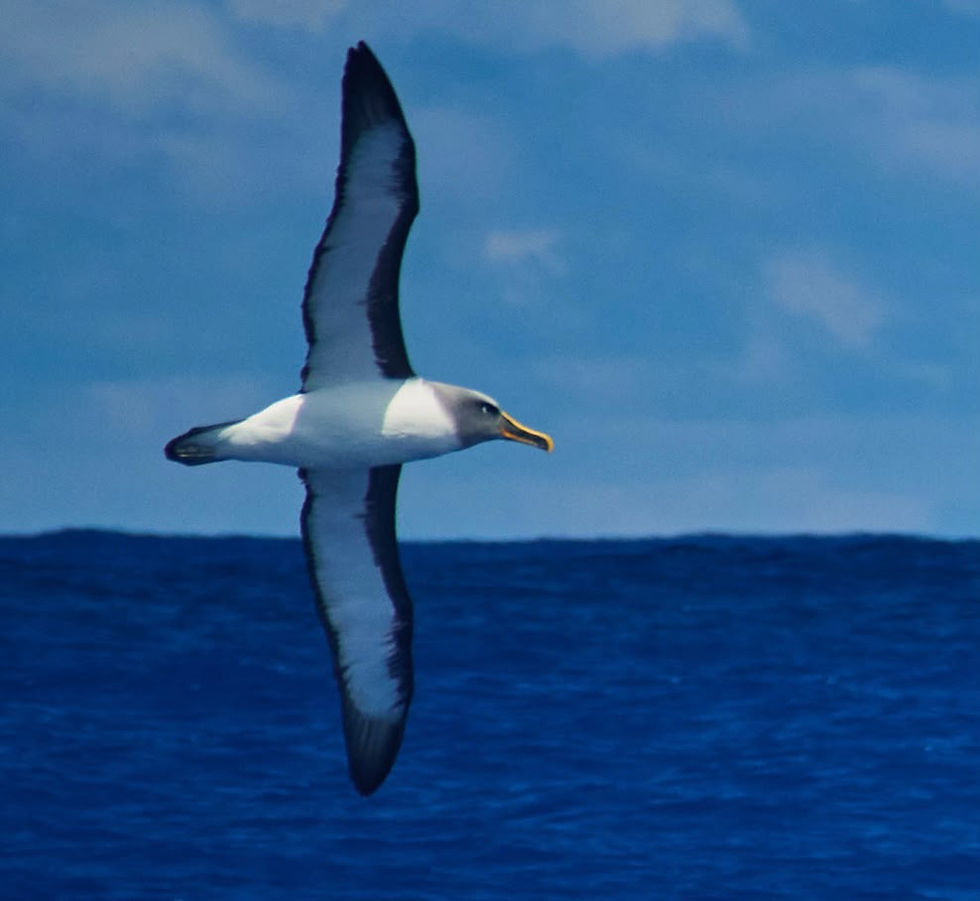
By Day 11 the weather forecasts were now predicting a huge ridge of high pressure dropping far south bringing our worst nightmare with it – flat calms. So once again to find the wind we steered south until on Day 16 we crossed 40 degrees of longitude. Our arrival in the Roaring Forties hit us with a bang, with a deep frontal system passing over us bringing driving rain and a full gale of wind.

Whilst these winds never exceeded 40 knots, the sea state became extremely nasty as strong northerlies piled head-on onto the huge prevailing 4-5 meter south westerly swell which had now been running for the last few days. As the night wore on, very steep short seas built up with large green water waves repeatedly breaking across the boat. On those occasions when we caught a large breaking wave hull-on it sounded like the boat being slammed by a sledgehammer.

On the second day of the gale we had to deal with a very alarming incident whereby our 45kg anchor broke free of its lashings, jumped out its bow roller and started banging into the hull. Although it had been tied down with four sturdy lashings, all of them had chaffed through with the severe motion of the boat. I was furious with myself for not having checked on the anchor more regularly and thus allowing such an un-seamanlike situation to occur. It was with the greatest of difficulty that Tom and I finally managed to get the miscreant anchor back on board and re-lashed down, which involved us both getting completed soaked to the skin in the 120 breaking seas, despite our state-of-the-art foul weather gear. I will never forget the extraordinary sensation of whilst hanging over the bow being completely submerged within a massive vivid green wave. Tom later described the experience as “duck-diving”, which means holding your breath before pushing your surf board under a wave.
Despite this one major incident , with just our double reefed mizzen sail and our heroic little storm jib set on the inner forestay, we were able to keep sailing the boat across the wind and I did not feel at any stage the need to either stop the boat and heave to or even run off before the wind.
After this gale had passed through, we made the most of 24 hours of calm and sunshine to repair minor damage across the ship and attempt to dry out our sodden foul weather gear before the next forecast round of strong winds hit us. This time it came in the form of the tail end of Cyclone Watti, an unprecedented early season tropical storm that had formed a week earlier in the Cook Islands fuelled by the prevailing extreme El Niño weather phenomenon. Saecwen took this next gale in her stride and we continued to make excellent progress, recording a further series of 24 hour runs between 150 and 170 miles.

No sooner had this passed through we were aware of the next big frontal system heading our way, with gale force conditions gusting from 40-50 knots predicted. On Day 23 we took this latest storm full on the beam and for the best part of 48 hours we reached across these winds under our tiny scraps of double reefed mizzen and storm jib, with the mainsail safely lashed down in the boom gallows. It was a relief when the front passed and that we could run once more before a fine 20 knot wind in dazzling bright sunshine.
We were now only a tantalising 400 mile from our Chilean landfall and our last three days of the passage witnessed some of the finest sailing any of us had ever experienced. With the wind firmly established in the northwest we broad reached under a heavily reefed main and small foresail. Given these amazing conditions we were delighted to give our long suffering hydrovane self-steering windvane a break and spend several exhilarating hours hand steering the boat, often surfing at over 10 knots before a fabulous following sea.
On day 25 the sea turned from deep blue to a jade green colour. We had entered the north bound Humbolt current and suddenly new forms of marine life started to appear around us – such as a huge flock of beautiful little black bellied storm petrels, who danced around the boat for several hours feeding in the nutrient rich waters. We were also amazed to see a large sea lion chasing the boat some 100 miles away from the nearest land.

At dawn on Day 28 Tom’s frantic clanging the ship’s bell and cries of “land ho!”, brought us all shooting up on deck and there on the starboard bow was the outline of Chiloe Island some 25 miles to the east.
As the day progressed by late afternoon we shot through Canal Chacao on a 5 knot flood tide into the wonderfully sheltered Golfo de Ancud. We were welcomed to Chilean waters by large groups of different sea birds, some Magellanic penguins, more sea lions and an amazing reception committee of dozens of leaping peales dolphins.
After a peaceful night at anchor off a deeply wooded island, the next morning we motored the last twelve miles to Puerto Montt, to be greeted by the wonderful site of Heloise frantically waving from the customs dock. Here she took our lines and her fluent Spanish guided us through the long but highly courteous process of clearing into Chile.
Saecwen had returned to the continent South America. We had made good 4,475 nautical miles from Rapa, averaging 24 hour runs of 160 miles over our 28 day voyage, making an average speed of 6,7 knots.
The passage had without any doubt been the most challenging undertaking Saecwen had yet to embark upon. However, the boat had performed magnificently. As had her amazing crew.
Other than the incidents of exhaust system failure off Rapa and then the unfortunate escaping anchor, the boat had suffered no serious mishap. Her ketch rig proved to be a superb solution to managing the repeated extremes of weather conditions we experienced, whereby dropping the mainsail to leave her sailing under just a reefed mizzen and storm jib enabled us to switch into “gale mode” with ease.

The one serious injury incurred was to my right-hand thumb. In the middle of the third gale, I managed to guillotine it in in the main companionway hatch. It’s bloody mass soon doubled in size due to severe swelling and on the crew’s insistence I took a course of antibiotics to ward of the potential danger of infection, which in the middle of the ocean would be no laughing matter. X rays on arrival in Chile revealed it had been well and truly crushed with multiple major fractures to its top end. Whilst the breakages were thankfully above the knuckle joint, an operation is now required to put it back together again.
On writing this we have now been in Puerto Montt for a week. Danny has just returned to his home in Sweden and Tom and Clemence are preparing to take their departures too. Long ocean passages are as much defined by companionship as they are by the actual physical demands of sailing of the boat. This had proven to be a truly exceptional crew, which had bonded together into an amazing team and who took on all challenges the mighty Southern Ocean threw fearlessly and with wonderful good humour.



Ray said well-done Crissy xx
Hi to you both wonderful photos Amazing trip that was, Hope your surgery goes well, all my love xx
Woweeee! What an amazing read.... it seems a world away. Many congratulations to the crew and the ship for such a successful and speedy passage. Sorry about your thumb Charlie! I guess you get to leave hauling ropes to others for a while. Hugs from Kilifi! XXX